Projects
Improving Global Search
Streamlining Information Architecture to Reduce Administrative Friction
Executive Summary
As part of Affinity’s company-wide Nail the Basics initiative, I led design for Global Search, a foundational workflow used by dealmakers to return to active companies, people, and notes during time-sensitive work.
Search results were frequently irrelevant, hard to disambiguate, and required multiple attempts to complete. Over three months, I partnered closely with product and engineering to drive discovery, run experiments under backend constraints, and ship scalable UX improvements.
While we did not achieve our primary conversion goal, we meaningfully reduced re-initiated searches (-14%), improved result quality, and uncovered systemic limitations of keyword-based search. This work directly informed the team’s strategic pivot toward semantic search.
"The internal search function has no optimization based on which people and organizations are most relevant to my business…"
Nail the Basics (NTB) was a company-wide effort to address core CRM functionality customers expect from a modern platform. Search emerged as one of the most critical—and fragile—experiences.
For Affinity’s customers (investors, dealmakers, and relationship-driven teams), search is not a discovery tool, it’s a return mechanism. Users often know exactly what they are looking for and need to retrieve it instantly, sometimes mid-meeting or conversation.
When search fails:
Deal momentum slows
Context is lost
Trust in the system erodes
Global Search produced inconsistent, hard-to-predict results that did not align with users’ mental models.
Key symptoms included:
Org-relevant companies ranking below unrelated global results
Difficulty disambiguating duplicates or similarly named entities
Limited result visibility (top 10 cap)
Unclear support for notes and other entity types
Root issue:
Search was optimized for broad keyword matching across Affinity’s global database, rather than relevance within a user’s specific network and workflow.
UI improvements can reduce friction but cannot fully compensate for poor ranking logic
Relevance is contextual and workflow-dependent
Preview-based context is more effective than forcing binary filters
Early experiments prevented deeper investment in ineffective approaches
Using Affinity's Build Operating Model (similar to dual-track discovery), I led problem framing through:
Historical customer feedback (Productboard)
In-product feedback loops
Ongoing customer interviews
Quantitative analysis in Amplitude
We mapped problems using a problem matrix (importance x satisfaction, tracing symptoms back to unmet user needs.
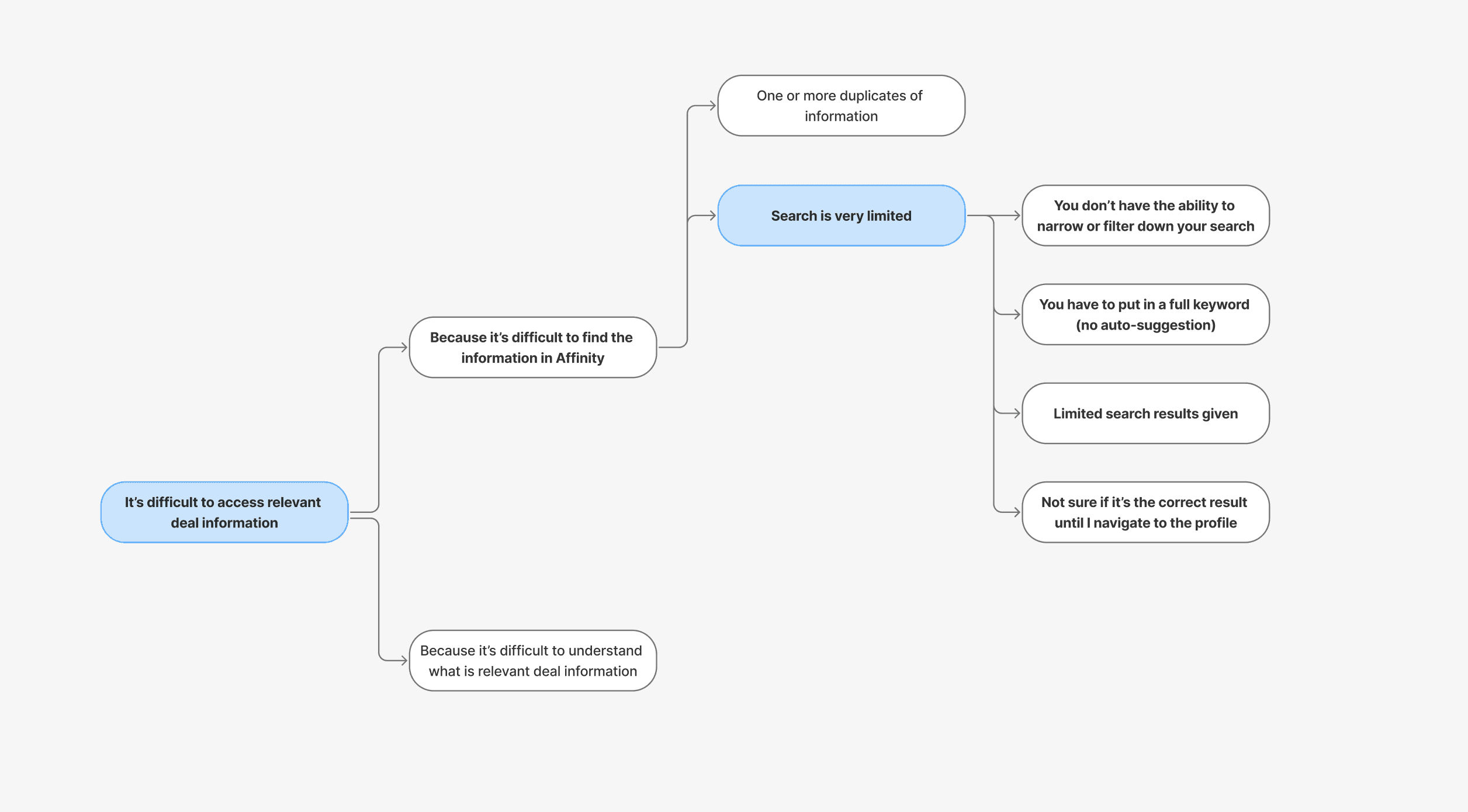
This work clarified that relevance and ranking, not UI polish, were the core issues to address.
At the outset, backend resources were limited. Rather than waiting, we used frontend-led experiments to:
Validate assumptions about relevance
Understand user mental models
Identify where UI could (and could not) compensate for ranking logic
Each initiative was designed to de-risk future investment, not just ship features.
Key Initiatives
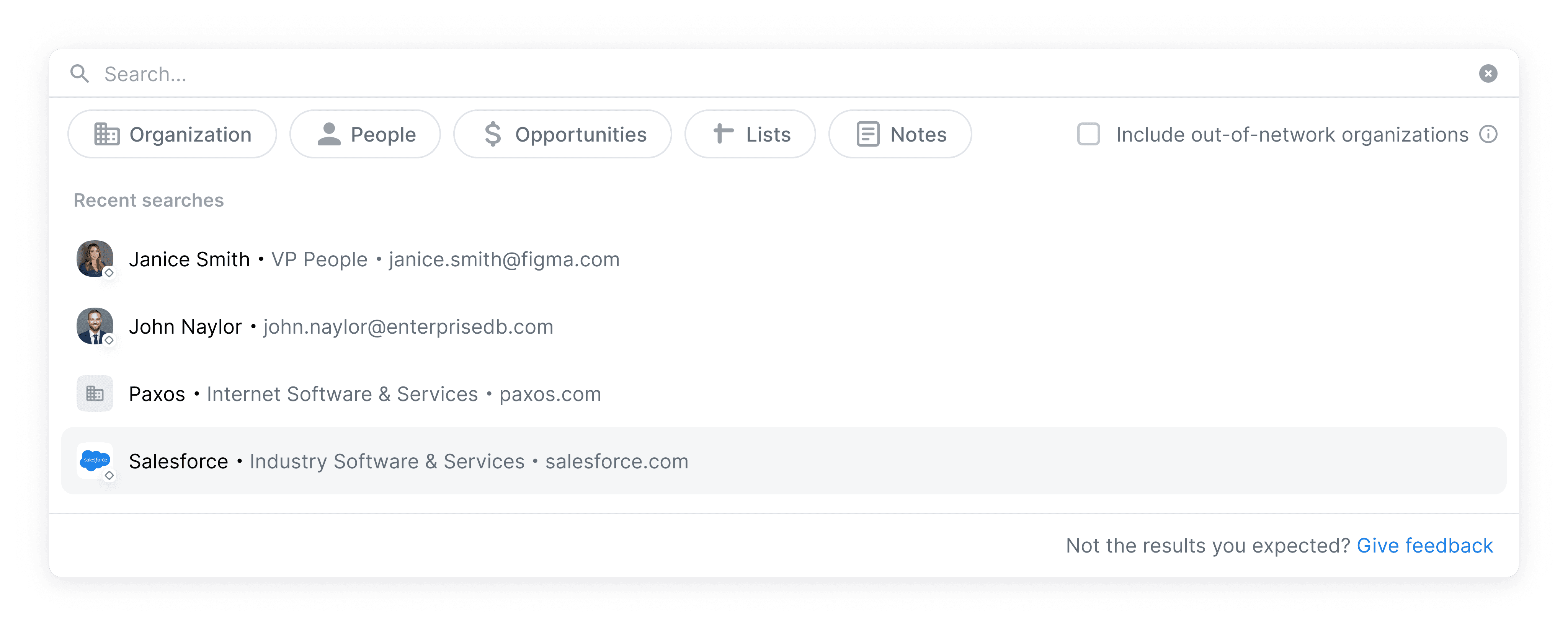
In-Network Filtering
We hypothesized that restricting search results to entities within a user's network would surface more relevant results and reduce failed searches.
Outcome:
Search conversion decreased slightly for the experiment cohort.
Why:
Users had mixed mental models of "in-network"
Some workflows (e.g., sourcing_ require open exploration
A binary filter forced tradeoffs rather than resolving ranking issues
What this taught us:
Relevance cannot be solved through filtering alone. UI controls surfaced tension between workflows but didn't resolve it.
"When I am using the search function I typically am waiting to search the entire universe of companies and people, not just those within our network. So this has added an extra step to my workflow."
Improve Discoverability & Reducing Friction
Discovery revealed UX inconsistencies that created unnecessary friction.
Notes were searchable but hidden behind a separate tab, limiting Notes conversion to just 24%
Results were capped at 10, forcing repeated searches
Changes shipped:
Result count increased to 20, with progressive "See more" loading
Clear messaging when users hit result limits
Notes surfaced in Top Matches by default
Impact:
Notes searches increased by 1,290% over a single quarter (from about 800 events in Q1 to over 12K events by end of Q2)
With "See more," 70% of users found their intended result within the first expanded view.
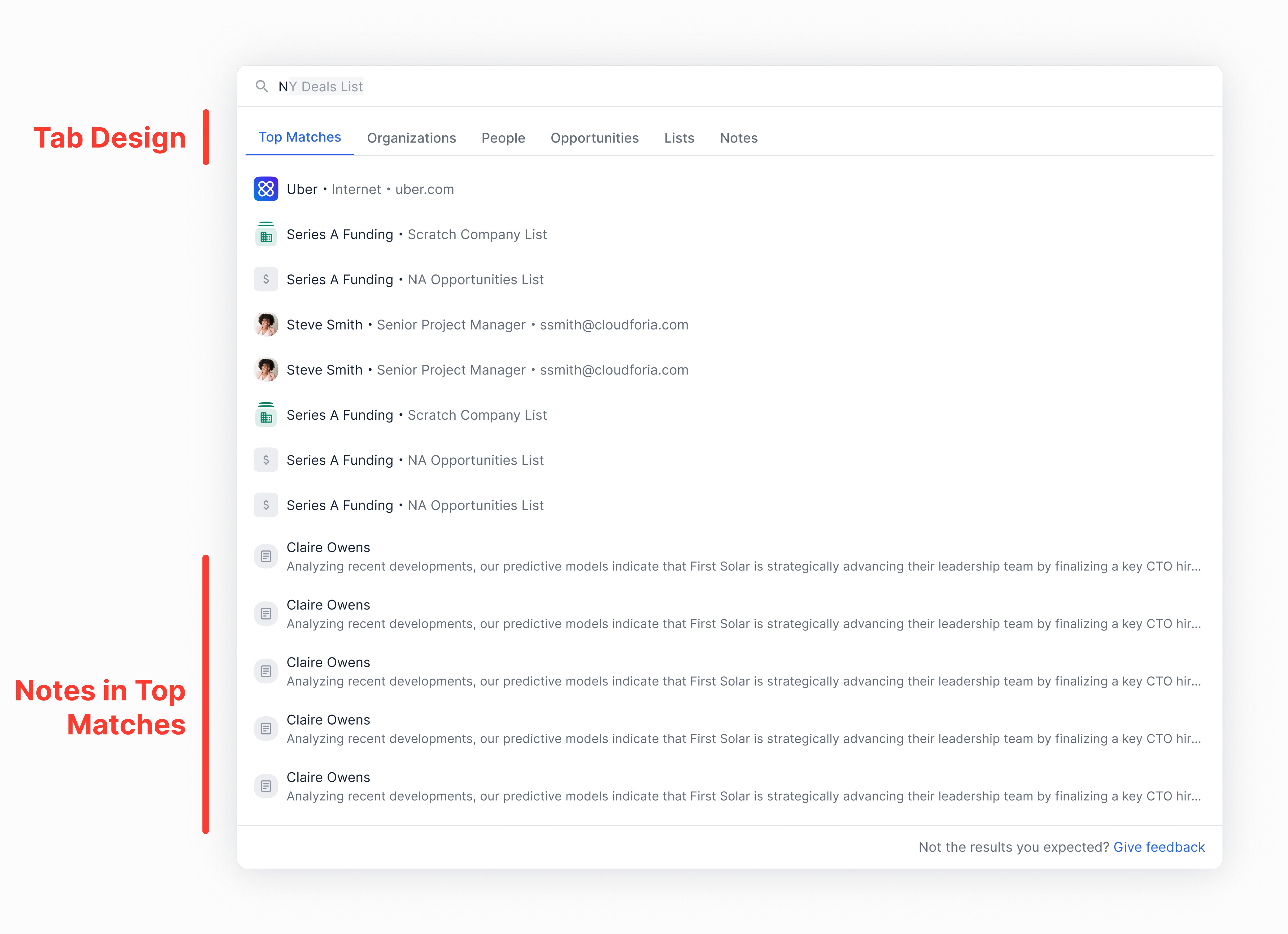
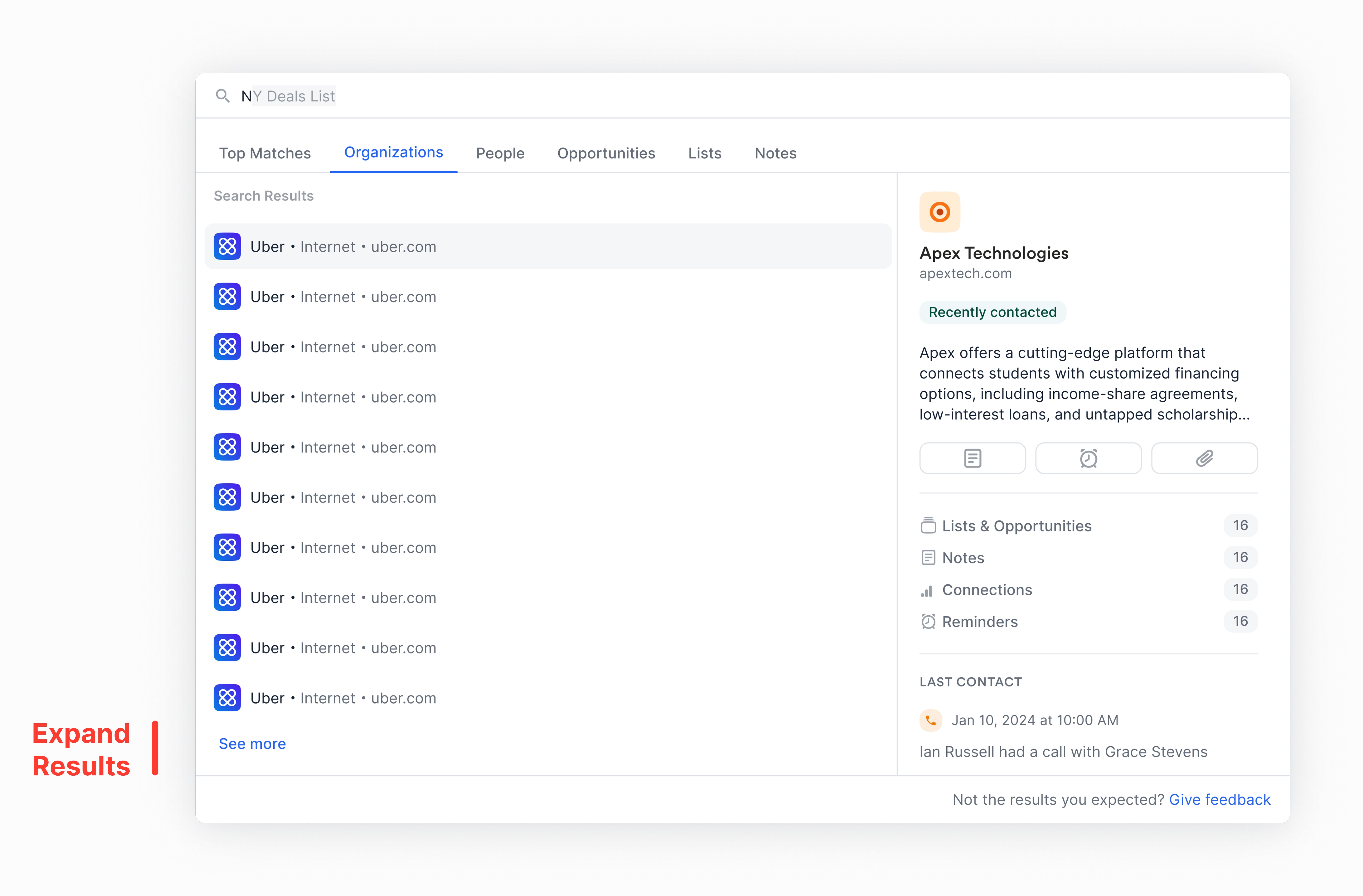

In search experiences, fewer interactions after result expansion indicated higher relevance and faster task completion
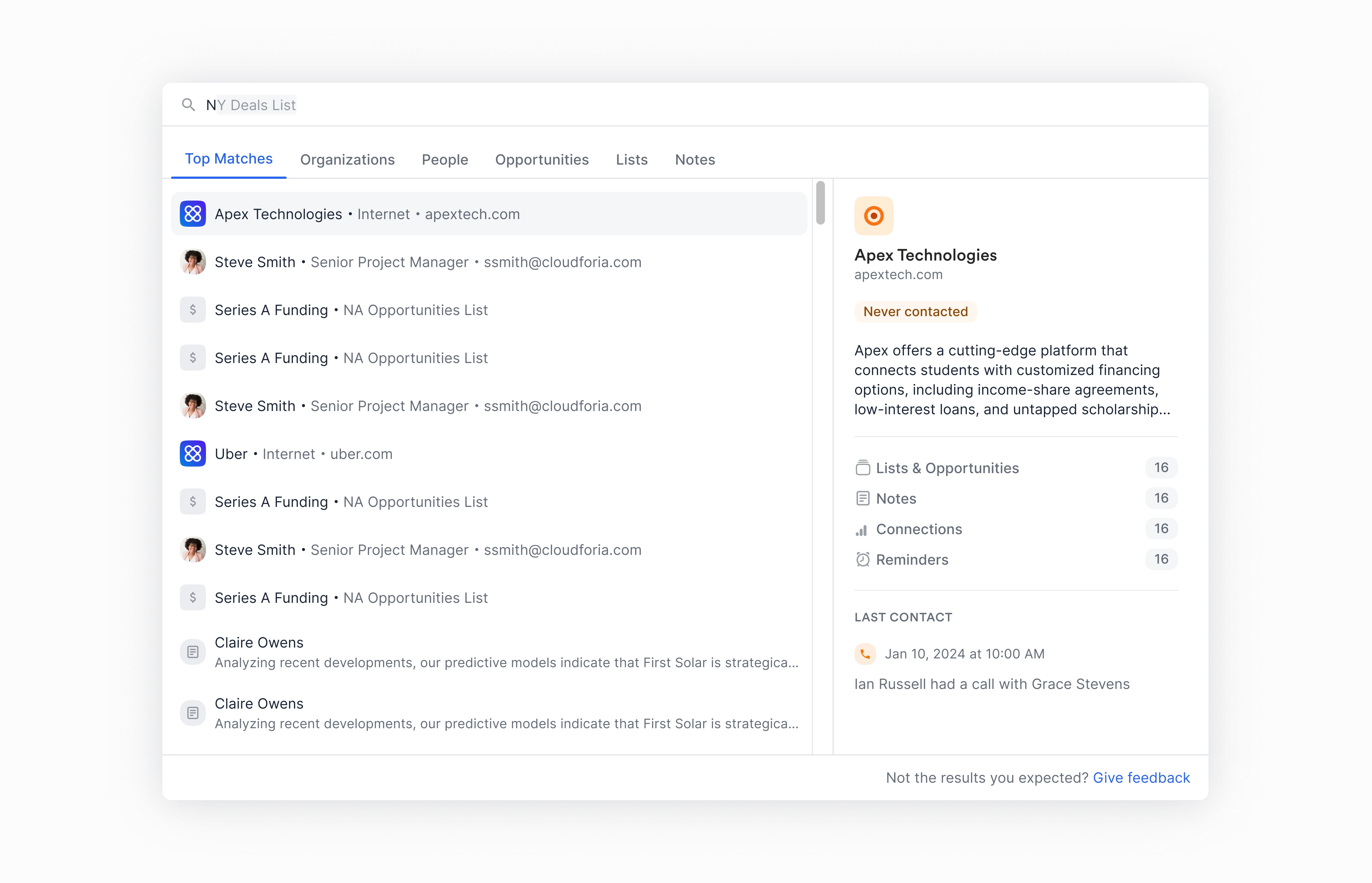
Search Preview: A Leverage Point
Ongoing discovery surfaced a recurring pain point: users couldn't confidently identify the right entity without clicking into multiple profiles.
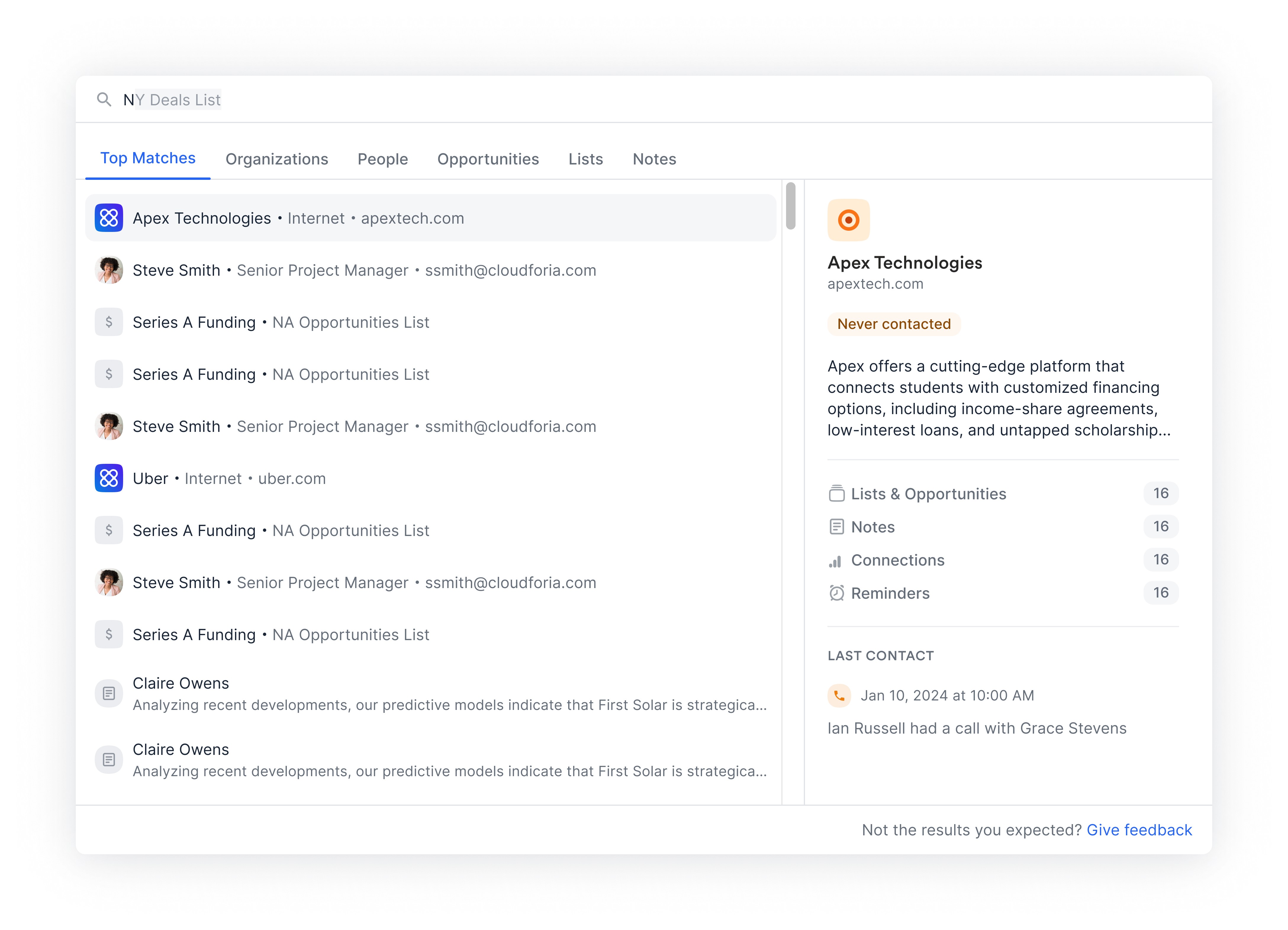
Key user questions the preview answered:
Is this the right company?
Has anyone on my team interacted with them?
Where does this entity already exist (lists, pipeline)?
MVP included:
Company descriptions for disambiguation
Interaction badges (Recently Contacted, Losing Touch, Never Contacted) for easy scannability
Last Interaction details when applicable
Lightweight activity counts with corresponding hyperlinks
Quick actions (add to list, add note)
This design was intentionally scalable and extended beyond web to mobile and browser extensions.
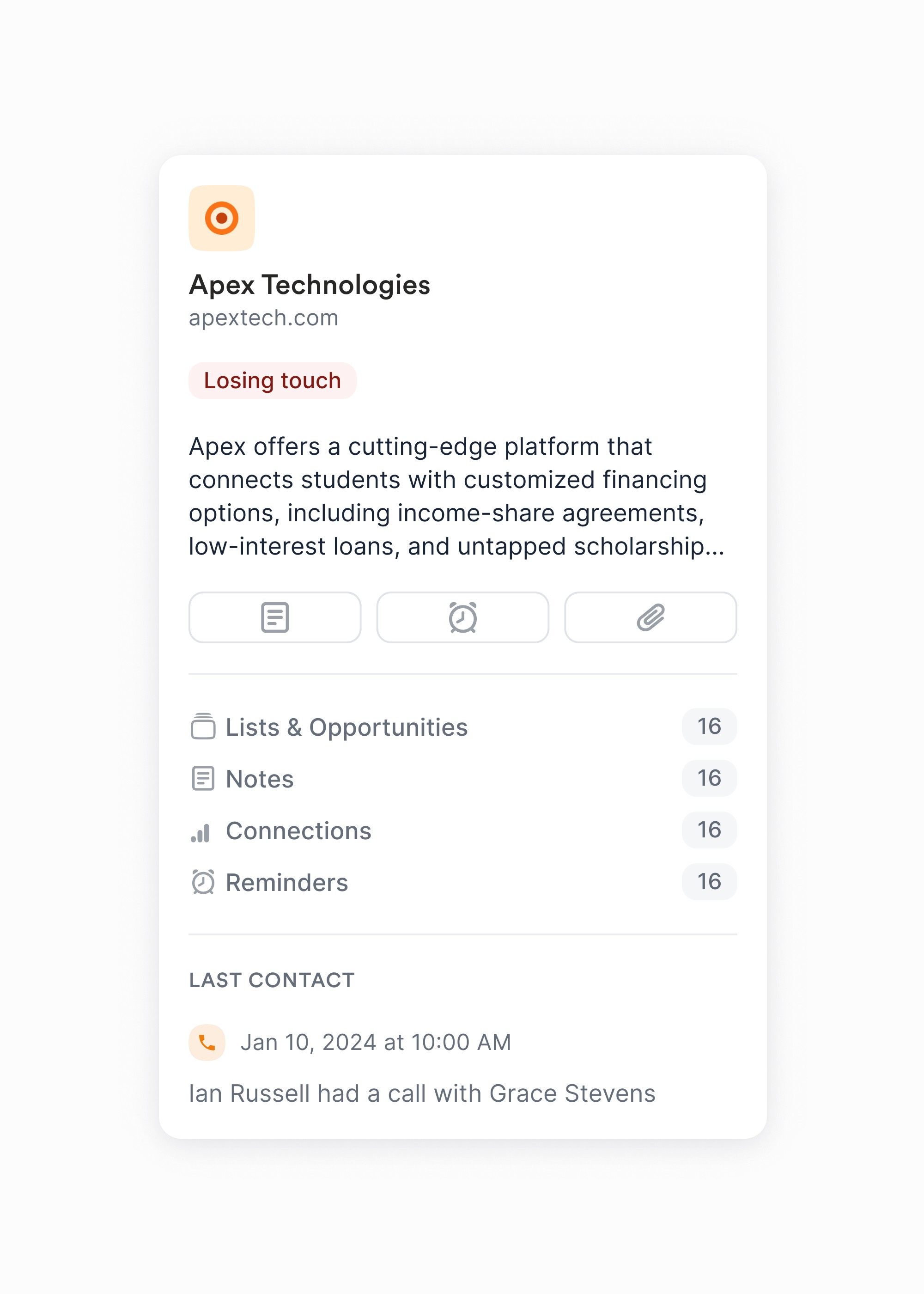
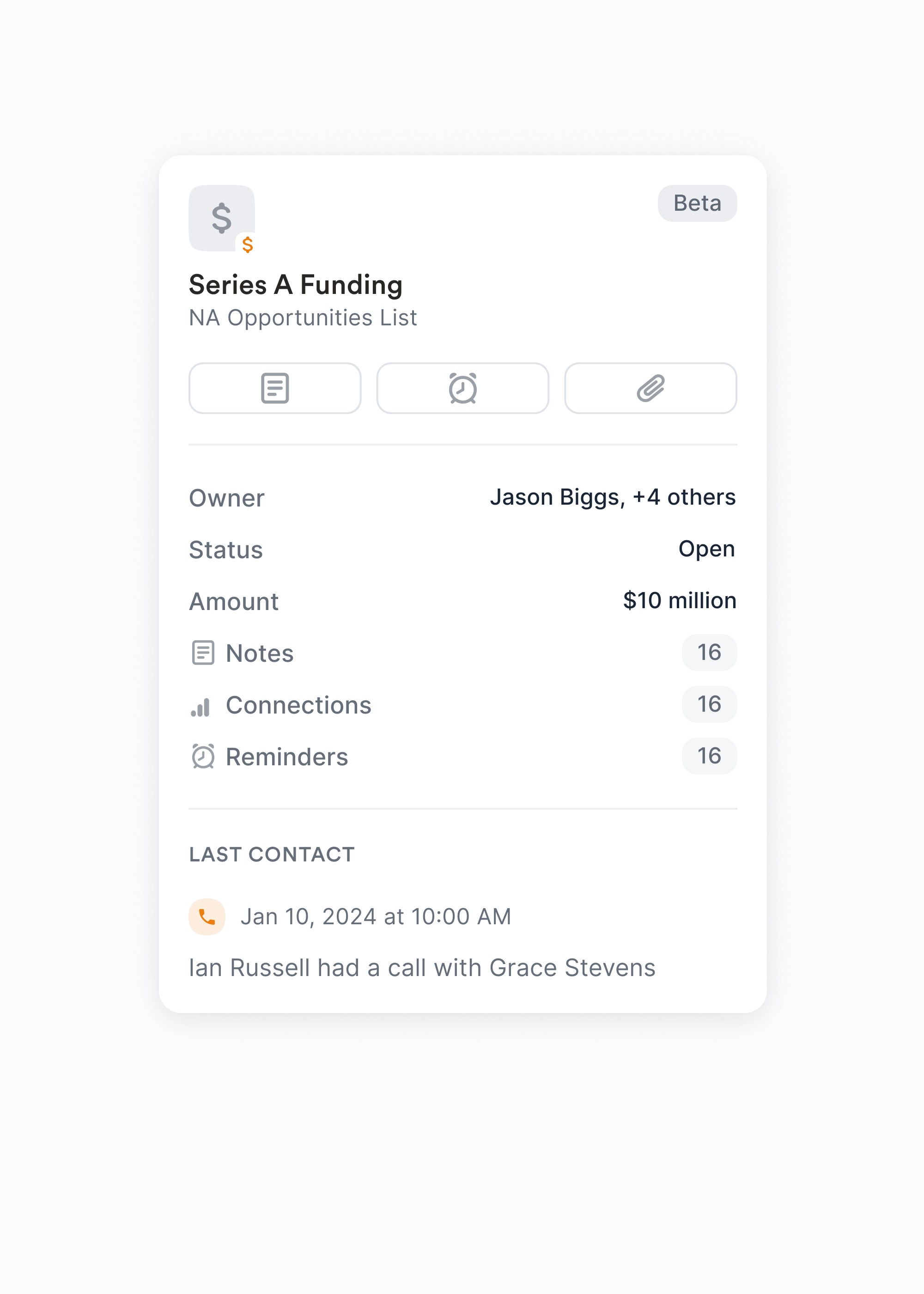
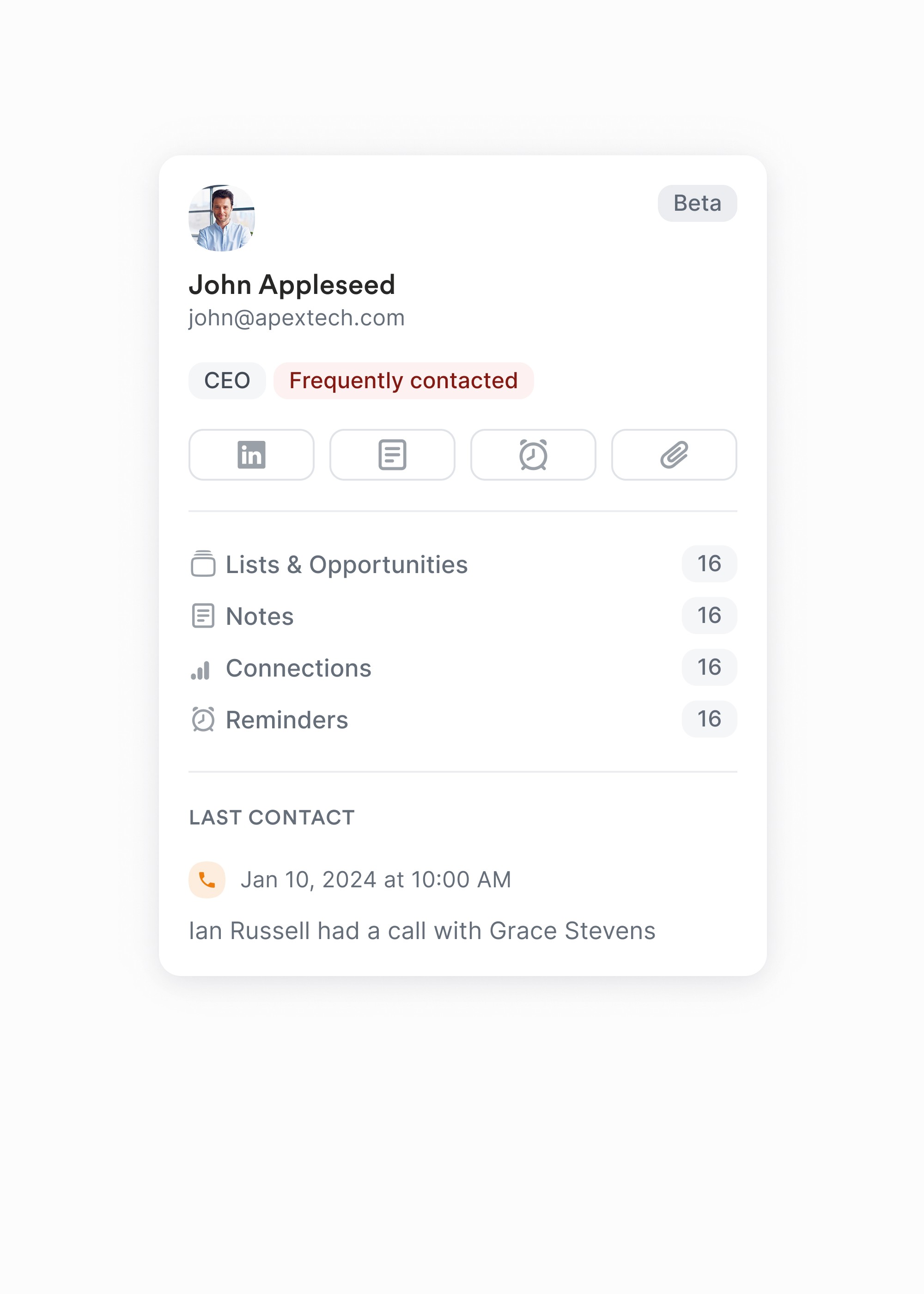
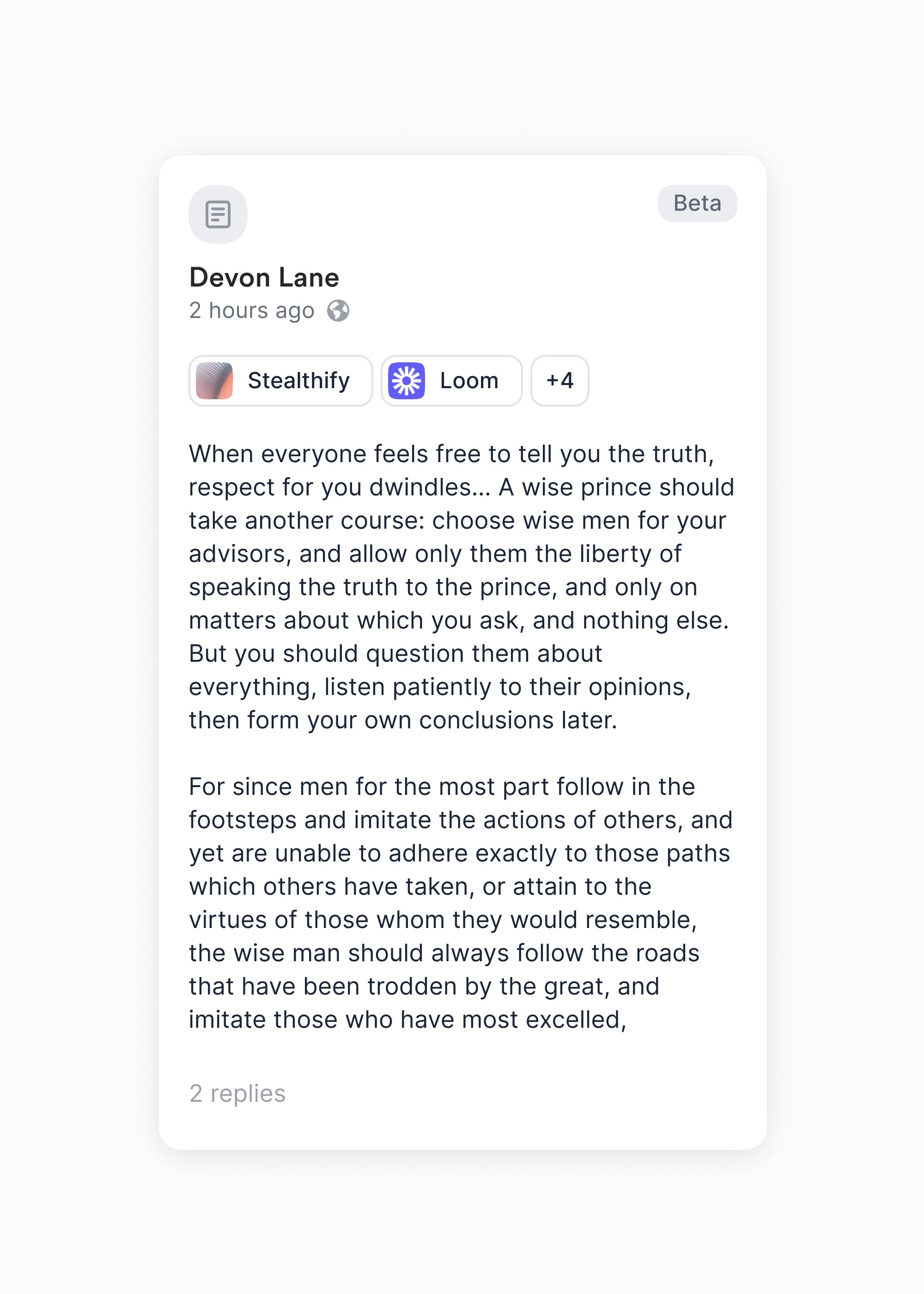
In search experiences, fewer interactions after result expansion indicated higher relevance and faster task completion
Primary Goal
Increase <10s search conversion by 10% —> Not achieved (conversion time increased by 4.5%)
Secondary Goal
Reduce re-initiated searched by 15% —> Exceeded (35%, driven by search preview)
Additional Positive Signals
Monthly completed searches increased by 24% from Q2 2024 to Q2 2025
94% of successful searches completed from top 3 results
Customer satisfaction remained stable with declining complaint volume
UI improvements can reduce friction but cannot fully compensate for poor ranking logic
Relevance is contextual and workflow-dependent
Preview-based context is more effective than forcing binary filters
Early experiments prevented deeper investment in ineffective approaches
This project reinforced an important lesson:
Success isn't always hitting the metric; it's creating clarity that changes direction.
The Global Search project proved that UI improvements could reduce friction but not fix relevance.
These learning directly informed Affinity's semantic search initiative, where we re-architected how results were indexed, ranked, and explained.
See the follow-up case study: From Keyword Search to Semantic Relevance (Coming Soon)